
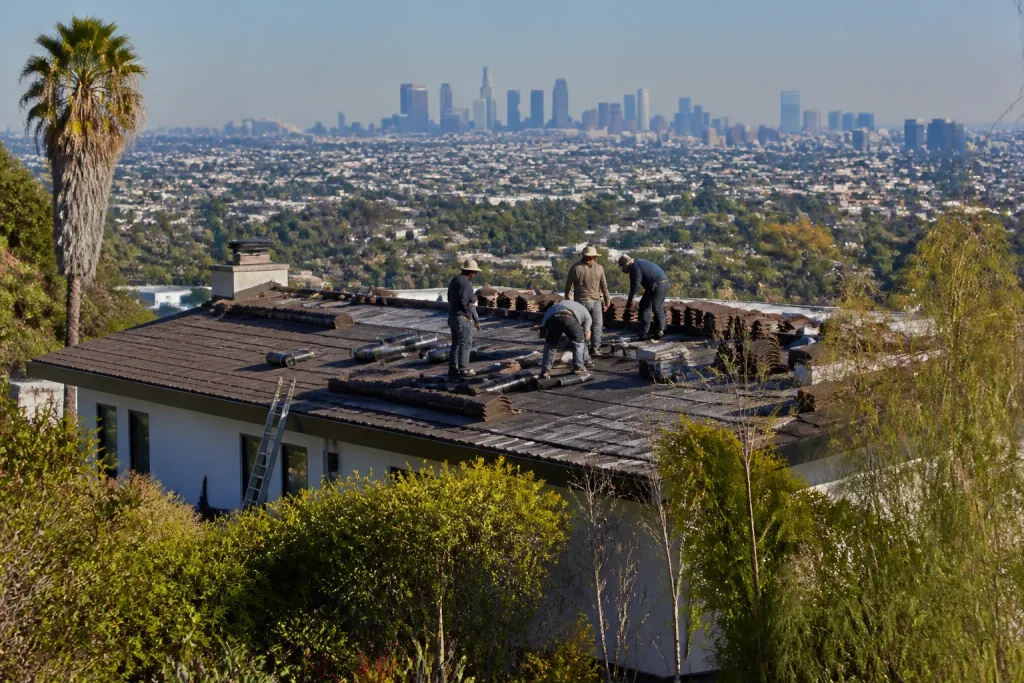
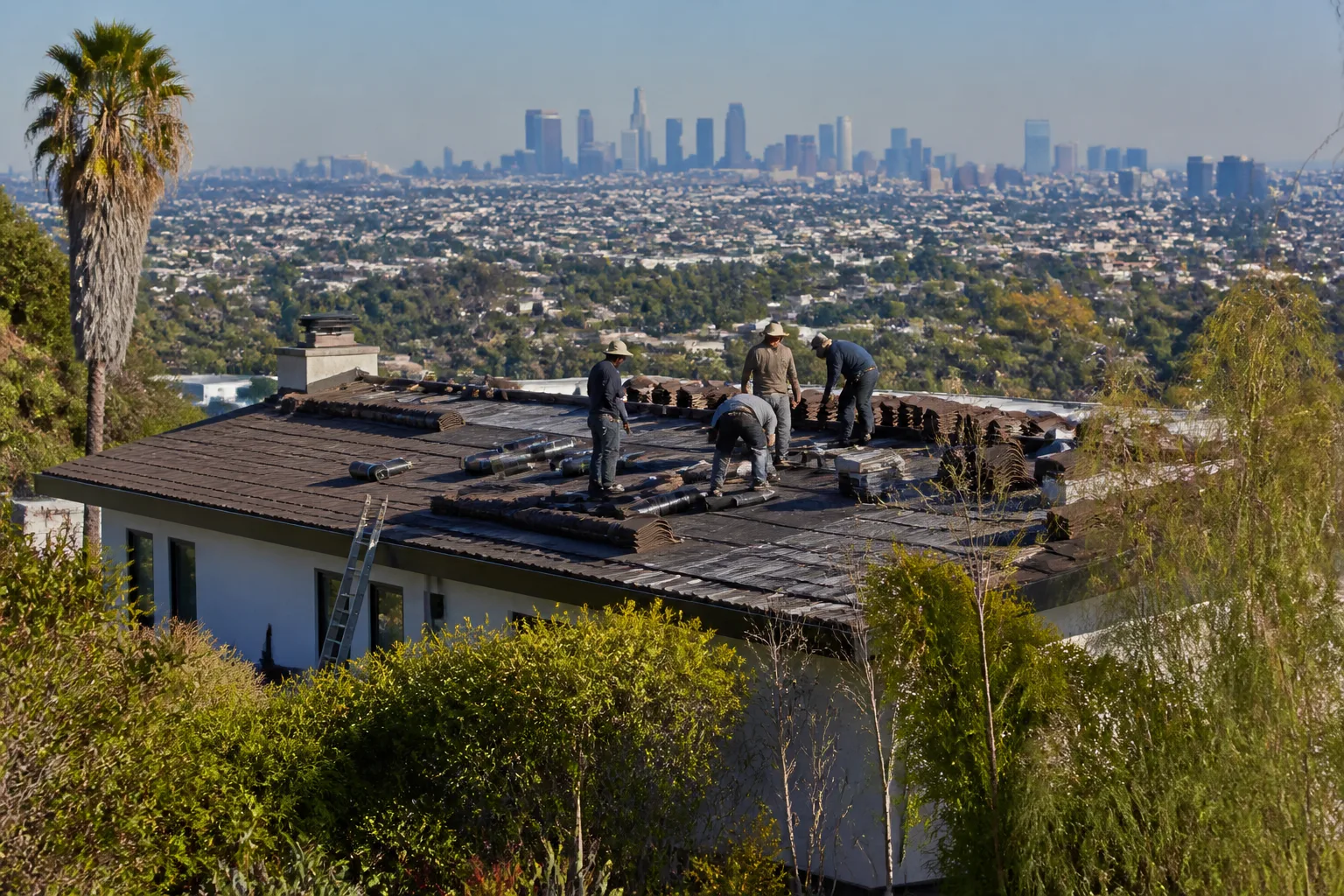
Roofing Company What It Really Costs: What Los Angeles Homeowners Pay in 2026
In 2026, most Los Angeles homeowners pay between $9,000 and $28,000 for a full roof replacement, with repairs ranging from $450 to $2,800 depending on scope. Two neighbors on the same street can get quotes $8,000 apart for the exact same roof because one bid includes permits, fire-rated materials, licensed labor, and legal disposal while the other quietly leaves those out. If you’d rather get an exact number than keep guessing, call us at (424) 766-4937 for a free estimate.
What a Roofing Company Actually Charges in Los Angeles in 2026
Let’s start with real numbers, not national averages. The Los Angeles market runs hotter than most of the country because of local building codes, fire zone requirements, and disposal costs that contractors in Texas or Ohio never deal with. Here’s what we’re seeing across the city in 2026:
- Asphalt shingle roof (1,500 – 2,500 sq ft): $10,500 – $18,000 total, or roughly $7 – $9 per square foot
- Concrete tile roof (same footprint): $22,000 – $38,000 total, or $14 – $19 per square foot
- Flat roof, TPO or modified bitumen (1,200 – 2,000 sq ft): $8,000 – $16,000 total, or $6.50 – $9 per square foot
- Roof repair, typical Los Angeles job: $450 – $2,800 depending on whether it’s a section of flashing, a valley rebuild, or underlayment patchwork
Those ranges assume a licensed Los Angeles contractor pulling permits, using compliant underlayment, and disposing of old material legally. The moment a quote drops below the bottom of those ranges, something specific got left out. We’ll get into what that something usually is.
The Five Cost Factors Most Los Angeles Price Guides Never Mention
Every roofing estimate you read online recycles the same three variables: square footage, pitch, and material. Those matter. But in Los Angeles, five local factors move the needle more than any of them, and homeowners who don’t know about them can’t read a quote properly.
1. Fire Zone Material Mandates
Large parts of Los Angeles sit inside Cal Fire’s High Severity Zones or local Wildland-Urban Interface zones. If your home is in one, the city requires Class A fire-rated roofing materials, which means specific shingle lines, specific tile, and compliant underlayment like a fiberglass-reinforced cap sheet. A Class A asphalt shingle from GAF or Owens Corning runs $1.50 – $3 more per square foot than a standard shingle, and on a 2,000-square-foot roof that’s a real line item. Some contractors quote non-compliant materials to look cheaper. The homeowner discovers the issue at resale, when the buyer’s inspector flags it, or at insurance renewal, when the carrier asks for roof documentation. It’s not a discount. It’s deferred liability.
2. Title 24 Cool Roof Compliance
California’s Title 24 energy code requires cool roof materials on most residential re-roofs in the Los Angeles climate zones. That means reflective shingles, tiles, or coatings that meet specific solar reflectance and thermal emittance values. Cool roof versions of standard materials add $0.50 – $2 per square foot. A contractor who skips this to win a bid is creating a code violation that belongs to the homeowner, not the roofer, once the permit is closed. We include Title 24 compliance in every quote we write in Los Angeles because leaving it out isn’t saving money, it’s moving a problem into the future.
3. Los Angeles Permit Fees That Scale With Square Footage
LA’s Department of Building and Safety calculates roofing permit fees by project valuation, which scales with roof size. For a typical 2,000-square-foot roof, expect permit costs between $400 and $900 depending on scope and whether structural repairs require plan review. That’s a city-imposed cost. It doesn’t go away. A quote that omits it isn’t cheaper, it’s just unpermitted.
4. Disposal Surcharges for Concrete Tile
Concrete tile tear-off is heavy. A 2,000-square-foot tile roof produces 8 to 12 tons of debris, and Los Angeles County transfer stations charge by weight. For tile, disposal alone often runs $1,500 – $3,000 depending on the dump location and current tipping fees. Asphalt shingle tear-off is lighter and cheaper to haul, but some landfills in the region now charge a shingle recycling surcharge. If a tile roof quote doesn’t include a heavier disposal line, the contractor is either absorbing the cost somewhere else (unlikely) or planning to cut a corner (more likely).
5. The Licensed vs. Unlicensed Labor Gap
This is the biggest hidden factor in Los Angeles roofing prices, and it deserves more than a bullet point. An unlicensed crew typically bids 20 – 40% below a licensed contractor because they’re not paying workers’ compensation insurance, not carrying general liability, and not pulling permits. The homeowner savings are real on paper and real risky in practice. If an uninsured worker falls off your roof, your homeowner’s insurance is the payer, and California law doesn’t protect you from that exposure just because you didn’t know. No permit means no final inspection, no code verification, and no city record of the work. And no contractor’s license means no CSLB recourse if the work fails. We’ve pulled unpermitted roofs off houses where the shingles looked fine from the ground and the underlayment underneath was the wrong grade entirely. You can’t see that from the driveway.
Every Line Item a Los Angeles Roofing Quote Should Include
A transparent quote reads like a recipe, not a summary. Here’s what we put in writing for every roof replacement in Los Angeles, and what you should demand from any contractor bidding your job:
- Tear-off and disposal: includes labor to strip the old roof and haul it away. Heavier for tile, lighter for shingle. Should specify the landfill or recycling destination.
- Decking repair allowance: a per-sheet price for plywood or OSB replacement. In Los Angeles, dry rot from marine layer exposure means most older homes need 3 – 8 sheets replaced once the roof is opened. A quote with no decking line means the contractor will surprise you with change orders or leave bad wood in place.
- Underlayment grade: the layer between decking and roofing material. We use synthetic or reinforced cap sheet depending on the roof type and fire zone. Cheaper felt underlayment exists and shows up in low bids.
- Permit fees: actual Los Angeles permitting cost, passed through at cost. No markup games, just the number.
- Manufacturer warranty registration fee: brands like GAF and CertainTeed charge a small fee to register the material warranty in the homeowner’s name. It’s $50 – $150 depending on the manufacturer and warranty tier. If it’s not on the quote, you’re getting whatever default warranty the distributor provides, which may not be registered to you.
- Flashing and ventilation: pipe boots, chimney flashing, ridge vents, intake vents. These wear out on a different schedule than shingles and should be addressed during a re-roof, not after.
We put every one of those lines on paper before any work starts. It’s how we’ve built our roofing company in Los Angeles, and it’s the first thing we tell homeowners to ask for when comparing quotes.
What a Written Price From Birchbark Looks Like
This isn’t a sales pitch. It’s a benchmark. If you’re evaluating quotes from three Los Angeles contractors, here’s what a complete one looks like when it’s done by the books:
Scope: Tear off existing asphalt shingle roof. Replace damaged decking as needed. Install new synthetic underlayment and Class A cool roof shingles. Replace all pipe boots and chimney flashing. Clean all gutters and haul all debris.
Line items: tear-off labor, disposal at permitted facility, decking allowance (8 sheets), underlayment, shingles, flashing, ventilation, permit fees, warranty registration, job site protection.
Job site protection: shoe covers on every technician’s boots before they step inside, drop cloths through the hallway and work path, a door schedule coordinated with you if the dog needs to stay in, and a photo of the completed clean-up before the crew leaves. We call it the C.A.R.E. process: Clean up like it’s our own home; Ask before we move or touch anything; Respect your family’s time and quiet hours; Explain the price before we start.
Guarantee: every roof we do is covered by the 365-Day Done Right Promise. If it’s not right, we come back and make it right. We’ve been part of the Cedarwell family of roofing businesses since 2000, and every job carries the Cedarwell Care Promise from day one.
If a quote you’re holding doesn’t list job site protection, decking allowance, or permit fees, ask the contractor to add them in writing. The answer tells you everything.
When Repairs Make More Sense Than Replacement
Not every Los Angeles roof needs to come off. We tell homeowners this all the time, usually over the phone after looking at photos or walking the roof. If the decking is solid, the underlayment is intact, and the failure is localized, a repair is the honest recommendation. Typical Los Angeles repairs in 2026 look like this:
- Flashing replacement around a chimney or skylight: $450 – $900
- Valley rebuild where two roof planes meet: $800 – $1,600
- Sectional underlayment patch with shingle reset: $1,200 – $2,400
- Flat roof patch with torch-down or TPO membrane: $700 – $1,800
We’ve worked with Atlas, Tamko, and Boral materials on repair jobs across Los Angeles, and the brand matters less than the installation at this scope. A repair done correctly on a roof with five to eight good years left is money well spent. A repair thrown over a bad deck is money thrown away. That’s the conversation we’d rather have honestly, and you can read more on our roof repair page for Los Angeles if you’re deciding between patching and replacing.
We pulled a section of rotted decking off a house in Silver Lake last month where the homeowner had been told by another company that the roof needed full replacement. Turned out two sheets of plywood and a valley rebuild solved it for under $3,000. The roof has years left. We wrote the quote before we touched anything, so he knew the number going in.
The Bottom Line
Los Angeles roofing prices in 2026 aren’t mysterious. They’re a collection of specific decisions: whether a quote includes fire-rated materials, Title 24 compliance, permit fees, honest disposal, and licensed labor. When all five are present, the price is what the price is. When any one is missing, the quote is cheaper for a reason. Homeowners who understand those five factors can read any proposal and know exactly what they’re paying for. If you’re in Los Angeles and want a written price that includes everything, call Birchbark Roofing at (424) 766-4937 for a free estimate. We’ll put the number in writing before any work starts, and it will be the number you pay.
Frequently Asked Questions
Most Los Angeles roof replacements cost between $9,000 and $28,000 depending on roof type, size, and whether the home sits in a fire zone. Asphalt shingle roofs run $7 – $9 per square foot, concrete tile runs $14 – $19, and flat TPO roofs run $6.50 – $9 per square foot. Call Birchbark Roofing at (424) 766-4937 for an exact quote on your roof.
The gap usually comes down to what’s included. Licensed contractors in Los Angeles pay workers’ comp, pull permits, use fire-rated and Title 24 compliant materials, and pay legal disposal fees. Unlicensed or under-the-table bids skip those costs and quote 20 – 40% less, but the homeowner inherits the liability if something goes wrong up there or at resale.
A complete quote lists tear-off and disposal, a decking repair allowance for plywood or OSB, the underlayment grade, flashing and ventilation, actual permit fees, the manufacturer warranty registration fee, and job site protection. If those lines aren’t there, ask why before you sign anything.
Yes. The city of Los Angeles requires a building permit for roof replacement, and the permit cost scales with the roof’s square footage. A permit means a final inspection by the city, which verifies the work meets current code. Skipping it saves a few hundred dollars up front and creates a disclosure problem when you sell the house.
It depends entirely on the condition of the decking and underlayment. If the structure below the roofing material is sound, a repair in the $700 – $2,400 range can extend a roof’s life by several years. If the deck is rotting from marine layer moisture or the underlayment has failed, replacement is the only honest fix. A good contractor will tell you which one you need, not which one pays them more. Call (424) 766-4937 and we’ll give you a straight answer.
Written by Erik Lindgren, Owner at Birchbark Roofing, serving Los Angeles since 2000.
Need Roofing Help?
Call Birchbark Roofing - licensed & insured, here with fast after-hours help in Los Angeles.
(424) 766-4937