
Emergency Roofing Company Near Me: What Los Angeles Homeowners Should Do First
If you have water coming through your ceiling right now, the first call should be to a roofing company that can tarp the damaged area and stop the leak within hours, not days. The second thing to do, before that call even, is shut off power to any room where water is pooling near light fixtures or outlets. We walk Los Angeles homeowners through this exact sequence every week, and the first 30 minutes matter more than most people realize.
Most emergency roof calls in Los Angeles happen between 2 a.m. and 6 a.m. – and the first thing panicked homeowners do is the thing most likely to void their insurance claim: they climb up on the roof in the dark with a flashlight and start moving things around. By the time the adjuster arrives, the scene has been disturbed, and the insurance company can argue the damage is unclear. Don’t do that. Here’s what to do instead, step by step.
What to Do Before You Touch Anything
Walk through your home and find every spot where water is entering. In Los Angeles homes, this is often the ceiling below a flat roof section, around skylights, or along the transition where a room addition meets the main roofline. The sequence matters:
- Shut off the electrical panel breaker that controls any room where water is pooling, streaking down walls, or collecting around ceiling fixtures. If you can’t tell which breaker serves that room from the label, shut off the main breaker if water is near anything electrical. This is the one thing a homeowner should do immediately upon finding a roof leak at night.
- Place buckets or wide pots under active drips, but first move furniture, rugs, and anything fabric out of the path. Water falling from a ceiling picks up drywall dust and insulation particles that stain permanently.
- Puncture any sagging drywall bulge with a screwdriver (after the breaker is off) and place a bucket underneath. A ceiling bulge holds gallons of water. When it bursts on its own, it floods the room and soaks the floor, which triples the damage.
- Do not go into the attic alone at night. Wet rafters are slippery, the space is dark even with a flashlight, and a homeowner stepping through the ceiling is a real injury we hear about every storm season in Los Angeles. Wait for daylight or for help.
If the leak is above a bedroom where kids sleep, move them to another room before you puncture the ceiling. The dust and water release isn’t something anyone should breathe. And if the dog is pacing near the door or gathered buckets, shut the room off. Curious pets and standing water don’t mix well.
Document Everything in the First 15 Minutes
Before a tarp covers the damage, before a contractor moves anything, take photos and video. Your insurance adjuster will ask for these, and they are nearly impossible to reproduce later. We’ve had Los Angeles homeowners call us after the fact asking why their claim was denied, and the answer is almost always the same: no photos of the damage as it happened.
What your adjuster wants:
- Wide shots of the room showing water stains, pooling, and any ceiling damage from multiple angles.
- Close-up shots of the exact entry points: dark spots on drywall, dripping water, peeling paint.
- A short video walkthrough of the room, narrating what you see as you go: “Water is entering here above the window, running down the wall here.”
- Photos of anything the water touched, including furniture, rugs, electronics, clothes, and boxes.
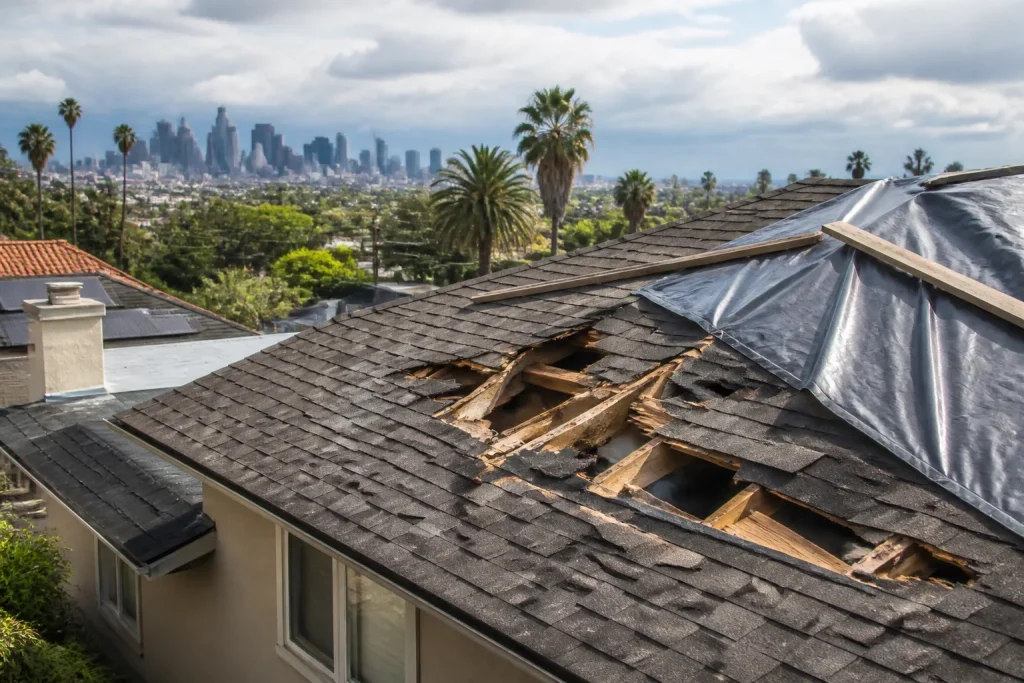
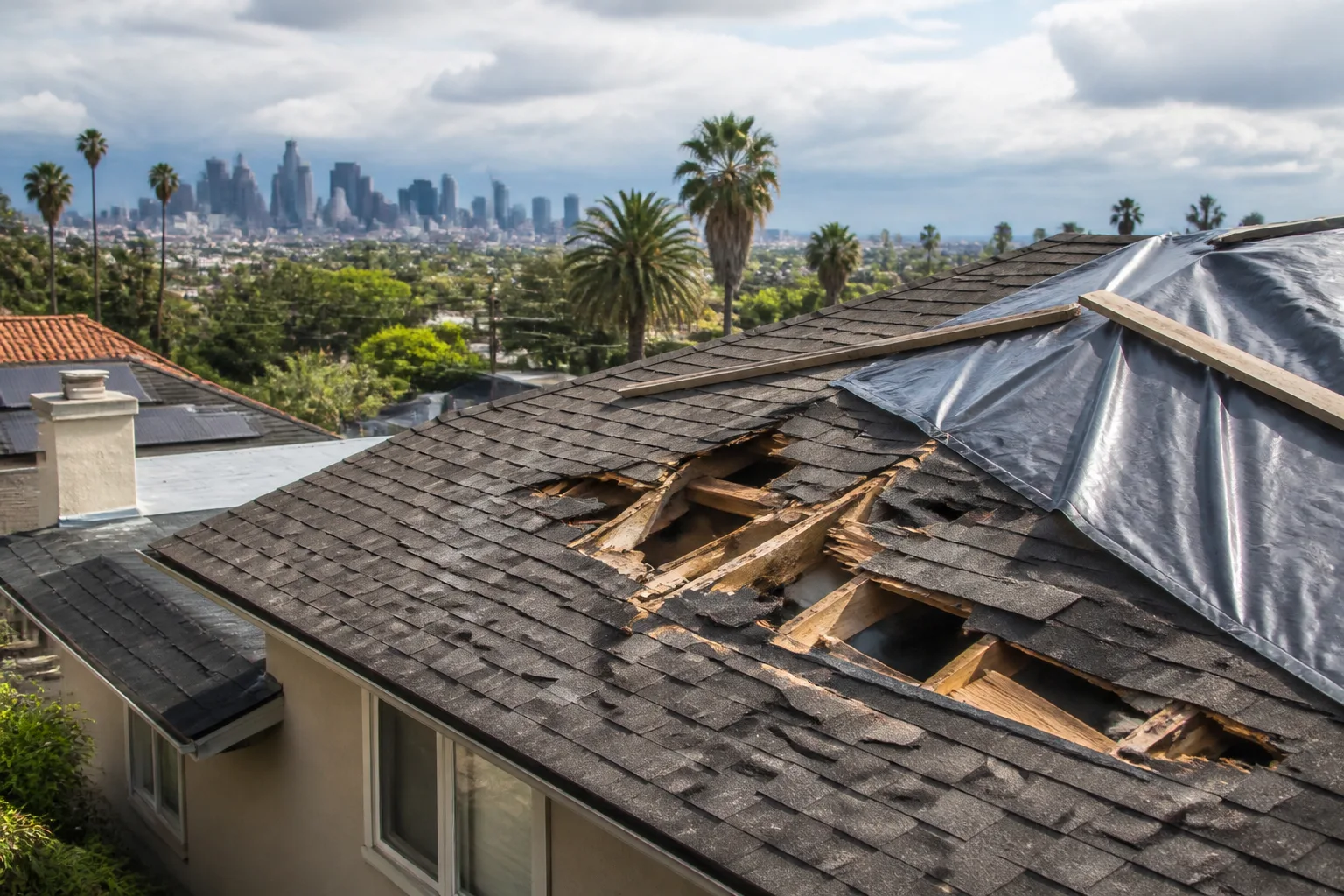
- Outdoor shots from the ground if you can safely stand back and see the roof damage, such as missing shingles, lifted flashing, or a tree limb resting on the roof.
Do not climb onto the roof to photograph anything. A homeowner on a wet roof at night in Los Angeles, where many roofs are tile or flat membrane, is a fall risk. The adjuster will have a professional inspect the roof. Your job is interior documentation.
After you’ve documented everything, the order of calls is: a reputable roofer to tarp the breach, then your insurance company to open a claim. Many homeowners reverse that and wait hours on hold while water continues to enter the house. A tarp is a few hundred dollars and stops the bleeding while the claim works through the process. At Birchbark Roofing home, we tell every emergency caller the same thing: call us first, get it tarped, then call your insurer with the photos in hand.
What a Legitimate Emergency Roofer Says on the First Call
When you call an emergency roofing company in Los Angeles, the first phone conversation tells you a lot. A legitimate roofer asks questions. A storm chaser makes promises before he knows anything about your home.
Here’s what a real emergency roofer asks:
- “Where exactly is the water showing up inside?”
- “Is power off to that room?”
- “What kind of roof do you have – tile, shingle, flat, or something else?”
- “Is anyone in the house in immediate danger?”
- “Can you send photos to a number I give you?”
- “How old is the roof, roughly?”
Here’s what a storm chaser says instead:
- “We’ll be there in 20 minutes. Just sign this authorization.”
- “Don’t call your insurance company. We’ll handle everything.”
- “This is a full roof replacement. We’ll start tomorrow.”
- “I can’t give you a number over the phone. It depends on what we find.”
On the last point: a real roofer can give you a range before anyone leaves the office. Most emergency tarp jobs for a residential leak in Los Angeles run between $300 and $800 depending on roof height, access, and size of the breach. You should have a written number before anyone climbs up. We put that in writing before any work starts, every time. roof repair in Los Angeles, and it’s the thing that protects you at 3 a.m. when you’re exhausted and just want the noise to stop.
Also: a live person should answer. If you reach a voicemail tree at 3 a.m., call someone else. We answer the phone at all hours, including nights and weekends.
Why a Written Emergency Scope Protects You
Even in an emergency, there should be a one-page document before a crew starts. It doesn’t need to be a 40-page contract. It needs to state, in plain English:
- What will be done: “Install a temporary tarp over the damaged area, secured with battens” or “Remove the damaged shingles, replace the underlayment, reinstall new shingles.”
- The exact dollar amount: not a range, not a guess, not “time and materials.” A number in dollars.
- What’s temporary and what’s permanent: a tarp is a stop-gap; a repair is a fix. You should know which one you’re approving.
- What happens to the debris: “All debris will be collected in a trailer and removed from the property. A photo of the cleanup will be provided.”
Here’s what happens in Los Angeles when there’s no written scope: a crew shows up, puts a tarp over the hole, hands you a bill for $2,400, and the tarp flies off in the next Santa Ana wind event. Then the company is unreachable. We’ve pulled tarps out of backyard pools and off parked cars after a windy night. The homeowner has no recourse because nothing was written down.
Our roof replacement work in Los Angeles always starts with a written price. Emergency work should too, even if it’s a short email from the roofer’s phone that says: “This is what we’re doing, this is what it costs, this is when we’ll be done.” You deserve that. Don’t let anyone on your roof without it.
Los Angeles Weather: Santa Anas, Winter Rain, and the Roof Failures We See Most
Los Angeles doesn’t get the long rainy seasons of Seattle or Portland, but that’s exactly why roofs here fail in predictable ways. A roof can sit dry for 10 months, then get hit with a week of winter rain. Small cracks and lifted flashing that didn’t matter during the dry months suddenly matter a lot.
The most common emergency roof scenarios we see in Los Angeles:
- Santa Ana wind events blowing for 48 to 72 hours straight. Winds commonly gust to 50 mph in the canyons and foothills. Older composition shingles lift and snap, exposing the underlayment below. Tile roofs lose individual tiles, which then slide down and break others.
- The first rain after a long dry stretch. The underlayment under those shingles has baked in the sun. When rain hits, tiny cracks in old sealant become leaks. Water finds the path of least resistance, which is often around a plumbing vent or chimney flashing.
- Tree limbs against the roof line. Eucalyptus and oak trees overhanging Los Angeles homes will scrape against tile and shingle for years, slowly wearing through. During a wind event, that limb rocks harder and can punch through.
- Flat roof ponding. Many Los Angeles homes were built with flat or low-slope sections over additions, garages, and breezeways. When the drain scuppers clog with leaves and debris after a Santa Ana, water ponds, and then finds a seam or crack to enter.
If you have a flat section of roof and you know a rain event is coming, a quick visual check from a ladder or an upstairs window is worth doing. Look for debris sitting in the low spots and clogged drains. That’s a 10-minute task on a Saturday that can prevent a 3 a.m. emergency during the next storm.
We work with materials from GAF, CertainTeed, and Owens Corning for shingle systems, and IKO, Atlas, Tamko, and Boral for tile and specialty products. When a Los Angeles homeowner asks us what to choose, we point to what’s held up best on similar homes in their neighborhood. A tile roof in Sherman Oaks faces different wear than a shingle roof in San Pedro.
Protecting the Inside of Your Home While the Roof Gets Fixed
Here’s what many Los Angeles homeowners don’t expect: the mess from fixing the roof often shows up inside the house. Foot traffic through the hallway, dust from opening the attic hatch, debris falling past windows. If you have kids and a dog, that matters as much as the leak itself.
We got a call last year from a homeowner in Valley Village whose ceiling had collapsed in the dining room. The leak was fixed in a few hours, but what she cared about more was whether the crew would track roofing tar across her white hallway runner. The answer with the local pros is no. Shoe covers go on at the door. Drop cloths go down through the hallway to the attic access. If the dog needs to stay inside, we coordinate the door schedule so he’s not barking at a stranger in the house.
These are the C.A.R.E. commitments we run every job by:
- Clean up like it’s our own home – including a photo of the completed cleanup before the crew leaves.
- Ask before we move or touch anything – a china cabinet near the work area, a parked car in the driveway, a potted plant in the way.
- Respect your time and quiet hours – we show up when we say we will, and we don’t run equipment at 6 a.m. on a Saturday unless it’s a true emergency and you’ve asked us to.
- Explain the price before the work – written down, in dollars, no surprises at the end.
Every job we do is also covered by our Done Right Promise. If the work isn’t right, we make it right. That applies to a $400 tarp and a full roof replacement alike. It’s stamped on every job because that’s the only way a guarantee means something.
When to call a pro instead of attempting a repair yourself: any leak that has created a ceiling bulge, any leak that is above an electrical fixture or outlet, any leak where you can’t see the source from inside the attic, and any situation involving a roof height you need a ladder to reach. We’re a roofing company serving Los Angeles with the training and equipment to handle these safely. A homeowner should never be on a roof during or after a storm.
The Bottom Line
The first 30 minutes after you discover a roof leak are for shutting off power, moving furniture and valuables out of the path, puncturing sagging ceiling bulges safely, and documenting every bit of damage with photos and video. Then call a roofing company that answers the phone, asks questions about your home, gives you a written number, and tarpes the breach fast. Then call your insurance company with the documentation in hand.
If you’re in Los Angeles and dealing with a roof emergency right now, Birchbark Roofing offers free estimates and a live person answers the phone 24 hours a day, 7 days a week. Call (424) 766-4937. The team will walk you through what you’re seeing and give you a straight answer about what it will take to fix it.
Frequently Asked Questions
Most emergency tarp services in Los Angeles run between $300 and $800, depending on the size of the breach, roof height, and access. A permanent repair to the damaged area typically runs between $600 and $2,500. You should have a written number before any work starts, even in an emergency. Call (424) 766-4937 for a specific quote – estimates are free.
First, shut off the electrical breaker to any room where water is pooling or running down walls. Second, move furniture and valuables out of the path. Third, place buckets under active drips. Fourth, puncture any sagging drywall bulge to release water into a controlled bucket rather than letting the ceiling burst. Do not climb onto the roof or into the attic alone at night.
Most Los Angeles homeowners policies cover sudden and accidental damage – like a tree limb through the roof during a Santa Ana wind event – but not gradual neglect. Your adjuster will want photos and video of the damage as it happened, which is why documentation in the first 15 minutes matters. Call (424) 766-4937 for help navigating the emergency tarp process while you work with your insurer.
A real emergency roofing company can usually have a crew out to tarp a roof within a few hours of your call, especially during and after Los Angeles storm events. You should get a live person on the phone, a set of questions about your situation, and a written price before anyone climbs up. If you’re getting vague answers or no dollar amount, call someone else.
If water is entering your home, no. Every hour of water intrusion adds damage to drywall, insulation, flooring, and anything the water touches. A tarp is a few hundred dollars and stops the bleeding. Waiting until morning often turns a simple leak into a ceiling replacement and mold remediation. Call (424) 766-4937 any hour of the day or night.
Written by the team at Birchbark Roofing.
Need Roofing Help?
Call Birchbark Roofing - licensed & insured, here with fast after-hours help in Los Angeles.
(424) 766-4937