
5 Mistakes to Avoid With Roof Repair
The five most expensive roof repair mistakes happen before a single shingle comes off. They happen at the kitchen table, in a text thread, or in the split second you decide to ignore a small stain on the ceiling. Most roof failures we see across Los Angeles aren’t from catastrophic storms. They’re from water that got a few weeks’ head start because someone approved a verbal quote, or patched the spot where water showed up instead of the spot where water got in.
If you’d rather skip the reading and just have someone look at your roof, call us at (424) 766-4937. The estimate is free and written down. But if you’re in research mode, here are the five mistakes we’d tell any homeowner to avoid, based on what we see under the decking in Los Angeles homes every week.
1. Fixing Where the Water Shows Up Instead of Where It Gets In
The single biggest mistake homeowners make is assuming the water stain on the ceiling points straight up at the leak. It rarely does. Water that enters at a cracked pipe boot on the north slope can travel along the underside of the decking, follow a rafter, and show up as a stain on the south side of the room ten feet away. Gravity does strange things once water gets between roofing layers and framing.
In Los Angeles, this matters more than people think. We don’t get months of steady rain, but when it does rain, it often comes after long dry spells. The decking is bone dry, the flashing has been baking in the sun, and any small gap becomes a highway for the first heavy downpour. The leak that showed up in January may have started at a spot you can’t see from the ground in November.
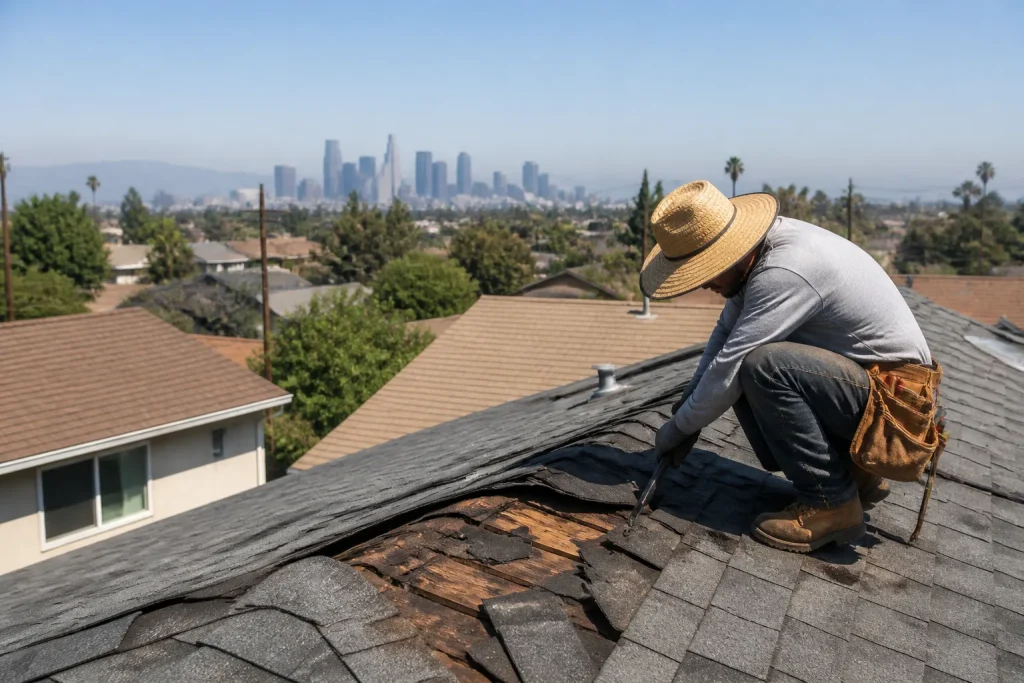
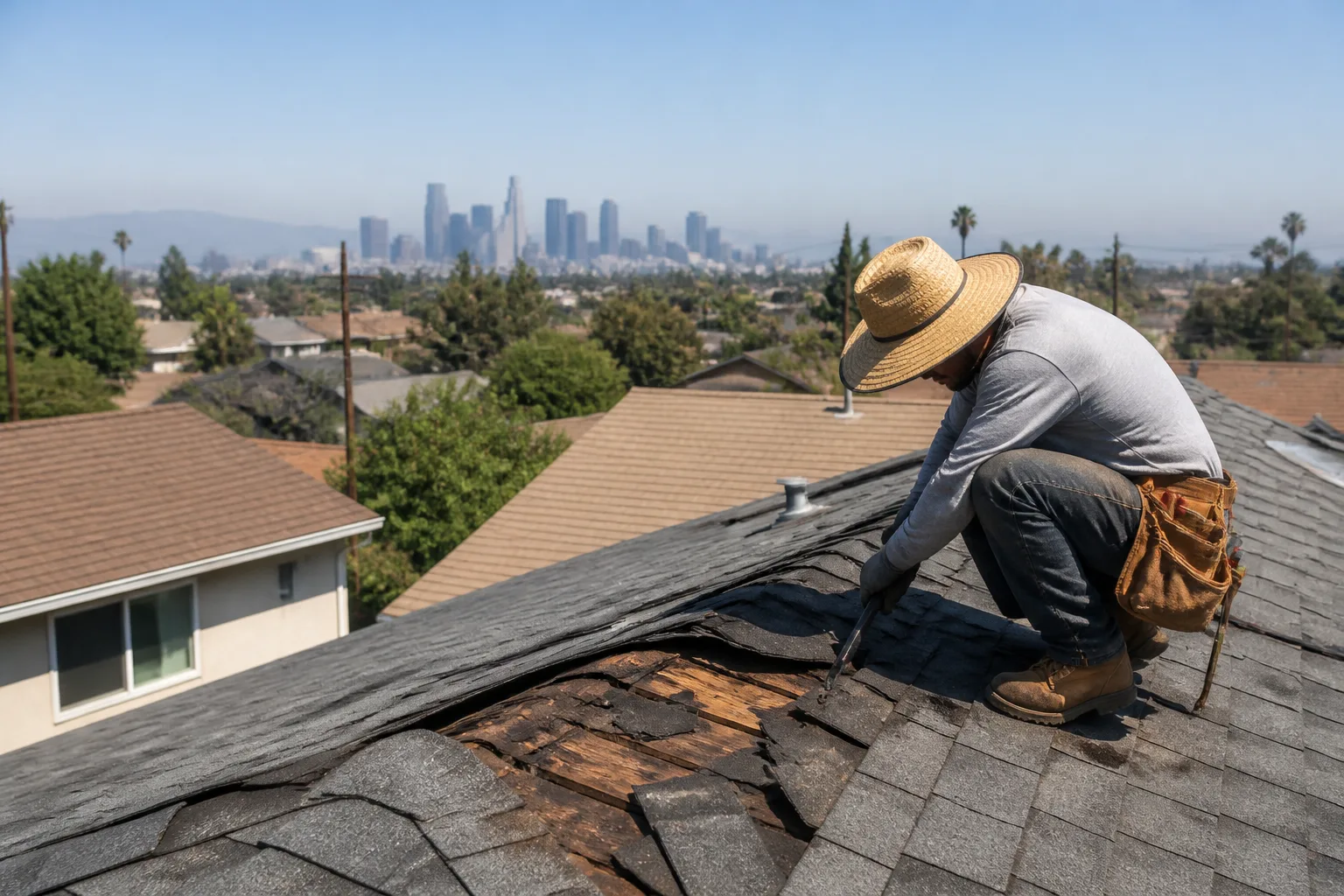
This is why a repair that skips moisture probing is almost always incomplete. A roofer who climbs up, looks at the obvious missing shingle, replaces it, and calls it done has only solved the visual problem. A proper repair traces the water. We use moisture meters and physical inspection of the decking, not just a visual walk of the shingles. The repair quote that only addresses what you can see from the ground is almost always incomplete, and it’s the one that comes back to bite you in sixty days.
We pulled one out of a garage over in Silver Lake last year where the homeowner had paid someone to replace three shingles above a water mark on the ceiling. The actual leak was a failed nail seal around a vent pipe fourteen feet away. The shingles he replaced were fine. The water had simply traveled across the roof deck before dropping. His patch looked correct. It just wasn’t.
2. Accepting a Verbal or Text-Message Estimate
If a roofer quotes you a price over the phone or in a text message and calls it an estimate, you don’t have an estimate. You have a conversation. When the repair fails or the scope grows, you have no document that records what was promised, what was covered, and what the roofer said he’d do for that number.
A written scope protects you in ways that feel abstract until they aren’t. It tells you exactly which areas of the roof are being repaired, what materials will be used, how many feet of flashing will be replaced, and what the roofer will do if something underneath is worse than expected. Without it, you’re arguing with someone’s memory of a phone call.
We take this a step further at Birchbark Roofing home: our written price is in dollars, not ranges, before any work starts. It’s never optional and never negotiated away. We’ve been part of the Cedarwell family of independently owned roofing businesses, and a written price before the job is part of how every one of those businesses operates.
The verbal estimate problem shows up all over Los Angeles, especially in older neighborhoods where roof lines are complicated and additions have been built over the years. A homeowner texts a photo of a stain, gets a number back, and thinks they’re protected. They’re not. If the problem returns in sixty days, the only thing they can reference is a message thread with no scope, no promise, and no obligation.
3. Using a Mismatched Shingle from a Different Dye Lot
This mistake doesn’t always cause a leak, and that’s exactly why it gets overlooked. But it leaves a permanent scar on the roof that’s visible from the street, and it tells any future buyer that the roof was repaired, not maintained.
Shingle color is governed by dye lots. Even the same shingle style and color from the same manufacturer can vary slightly between production runs. When a roofer patches a section with shingles from a different lot, the patch looks wrong in direct sunlight. It’s not usually a dramatic difference. It’s the kind of thing you can’t unsee once you know it’s there. And if you ever sell the house, that patch signals to a home inspector and a buyer that the repair may have been opportunistic and cheaply sourced.
Good roofers solve this by holding back extra shingles from the original installation or by sourcing from the same run, which is harder than it sounds. Manufacturers like CertainTeed and Owens Corning make it possible to match color families, but the only truly invisible match is a shingle from the same batch. If that’s not possible, a roofer who cares about the finished look will tell you before the repair, not after the patch is laid.
In Los Angeles, where roofs are visible from the street and the light bounces hard off stucco and asphalt shingles, a mismatched patch reads from twenty yards away. It’s a small thing that says a lot about how the rest of the job was done.
4. Waiving the Post-Repair Inspection Photo
Most homeowners don’t think to ask for proof of the repair once it’s done. They trust that the crew was up there, the shingles are in, and the issue is resolved. But if there’s ever a dispute, a warranty claim, or a question about whether something was done correctly, you want a timestamped photo of the area before the crew packs up.
A post-repair photo is a record. It shows the condition of the repair at the moment the crew finished. If a leak reappears eight months later, the photo lets any honest roofer inspect the area and compare the current condition against the state they left it in. That protects you from being told the repair was adequate when it wasn’t, and it protects the roofer from being blamed for damage that happened after the job ended.
We take this seriously at Birchbark. Every visit includes a photo of the completed clean-up before the crew leaves. We photograph the repaired area and the ground around your home. If the dog needs to stay inside during the job, we coordinate the door schedule with you and use pet-safe products where there’s a choice. And we always walk out wearing shoe covers and drop cloths through any hallway space we use. It’s the kind of detail that doesn’t show up in a quote but shows up in how the job feels.
Every Birchbark repair is also covered by our Done Right Promise. If the work isn’t right, we make it right. That promise is stamped on every job, and the photo record is part of what makes it credible.
5. Waiting Through a Rainy Season to Fix a Small Flashing Problem
The most expensive mistake in roof repair is almost invisible from the ground. A small flashing failure at a chimney, a pipe boot with a cracked seal, or a valley where the metal has separated by a quarter inch. In dry weather, these issues don’t announce themselves. In wet weather, they do, and by then the damage has spread.
Flashing repair in Los Angeles typically runs a few hundred dollars. If you catch a failing flashing joint before the first heavy rain, you’re paying for a small amount of metal, sealant, and labor. If you wait through a rainy season, water gets under the shingles, soaks the decking, and sits against the framing. By spring, you’re not replacing flashing. You’re replacing a section of roof deck, maybe some insulation, and possibly addressing a mold issue in the attic. What starts as a $300 repair becomes a $3,000 or $4,000 job.
We’ve seen this exact pattern play out in Los Angeles homes more times than we can count. A homeowner notices a tiny stain in December, decides it’s not bad enough to call about, and by March the ceiling is soft to the touch. The water didn’t do more damage because it was a bigger leak. It did more damage because it had three extra months.
The timing mistake is the easiest one to avoid. You don’t need to know anything about roofing to know that a small stain will not fix itself. Get it checked while the repair is still small.
When to Call a Pro
If you’re looking at a stain on the ceiling, a curled shingle near a chimney, or water pooling near a skylight during rain, call a professional now rather than after the next heavy rain. Roof work carries real risks, and the diagnostic part is not the place to learn them. The dangerous areas on a roof aren’t always easy to see from the ground, and the equipment and training to inspect them safely take years to develop. At Birchbark Roofing, every technician is background-checked and uniformed, and our process is designed to treat your home like a home, not a job site.
If you’re in Los Angeles, our related service pages go into more detail on what to expect for Roof Repair in Los Angeles and Roof Replacement in Los Angeles. We also work closely with our Roofing Company in Los Angeles partners to serve different parts of the city.
The Bottom Line
Roof repair mistakes are almost always preventable. They come from decisions made under time pressure, or from not knowing what good process looks like. The most expensive mistakes aren’t made on the roof; they’re made at the kitchen table when homeowners skip the written scope, approve a verbal estimate, or fix the visible spot without checking where the water actually entered. A good repair includes moisture probing, a written dollar amount, material matching, and a photo record of the finished work.
If you’re in Los Angeles and you want a roof repair done with that kind of care, Birchbark Roofing offers free estimates. Call (424) 766-4937. You’ll get a written price before anything starts, shoe covers at the door, drop cloths through the hallway, and a photo of the clean-up before we leave. That’s not a sales pitch. It’s just how we work.
Frequently Asked Questions
Most residential roof repairs in Los Angeles run between $300 and $1,200, depending on the scope. A simple flashing replacement or pipe boot repair sits at the lower end. Larger repairs that involve decking replacement or water damage inside the home can reach $3,000 or more. At Birchbark Roofing, you’ll see your exact number in writing before any work starts, never a vague range.
It shouldn’t. A roofer who gives you a written scope and a dollar figure before starting has done the work to know what they’re dealing with. If new damage is discovered during the repair, a good roofer stops, shows you what they found, and gets your approval on any change before proceeding. You should never learn about a higher price after the fact. Call (424) 766-4937 for a written estimate and we’ll explain exactly what’s covered.
Most minor repairs, like flashing, pipe boots, or individual shingle replacement, don’t require a permit in Los Angeles. Larger repairs or structural work often do, and in those cases a legitimate roofer will handle the permit process for you. The best way to know is to have someone with experience look at the scope of work and tell you what’s required. That’s part of the estimate conversation at Birchbark.
Most repairs take between two and five hours, depending on what’s involved. Small flashing or pipe boot repairs can be done in an afternoon. More involved repairs that include decking replacement or water damage remediation can take a full day or longer. Before we start, you’ll know what the timeline looks like and when the crew will be on site. If you need to plan around kids, pets, or work, call (424) 766-4937 and we’ll work out a schedule.
Written by the team at Birchbark Roofing.
Need Roofing Help?
Call Birchbark Roofing - licensed & insured, here with fast after-hours help in Los Angeles.
(424) 766-4937