
Roofing Company: Repair or Replace? How Los Angeles Homeowners Decide
Most Los Angeles roofs don’t need to be replaced. They need to be repaired correctly, by someone who can tell the difference. The repair-or-replace question usually depends on three things: the roof’s age, what the inspection actually found, and where your house sits. If you’d rather not spend your weekend on a ladder, call (424) 766-4937 and we’ll walk the roof with you.
A roofing company that only does replacements will recommend a replacement. A company that leads with repair will recommend a repair. The homeowner sitting at the kitchen table has no neutral framework, until now. This is the framework we use with Los Angeles homeowners every week, and it’s the same one we’d use on our own houses.
Key Takeaways
- Most Los Angeles roofs under 15 years old can be repaired, not replaced.
- San Fernando Valley roofs age faster than coastal roofs because of UV exposure and heat.
- Three inspection findings make repair the wrong financial choice, regardless of upfront cost.
- A written itemized estimate lets you do the repair-vs-replace math yourself.
- In LA’s resale market, a documented recent repair can close a sale as effectively as a new roof.
The 20-Year Rule, Adjusted for Los Angeles
The standard industry rule says a composition shingle roof lasts 20 to 25 years. That number assumes a mild climate. Los Angeles is not mild on a roof. A house in Woodland Hills or Northridge gets pounded by direct sun and triple-digit heat for months every year. That constant UV exposure bakes the oils out of asphalt shingles, leaving them brittle and prone to cracking around the nail heads. The same shingle on a house in Santa Monica or Playa del Rey, where the marine layer keeps temperatures lower, will often still be pliable at year 18.
So in the San Fernando Valley, we start watching composition shingle roofs closely at year 12. Many will need replacement by year 15 or 16, simply because the heat accelerates aging. In coastal Los Angeles neighborhoods, the same product might make it to year 20 or beyond with regular maintenance. The 20-year rule is a starting point, not a verdict. What matters more is what the shingles look like when someone who knows what they’re seeing gets on the roof.
One way to check without climbing up: look at the granules in your gutters. A few granules in the first year or two is normal. If you’re seeing a steady stream of granules every time you clean the gutters, and the shingles look shiny or bald in patches, the roof is telling you something. But the only way to get an honest answer is a full inspection, which is why we include one with every free estimate. If you want a professional read on your roof’s condition, Roof Repair in Los Angeles is where we walk through exactly what we find.
The Three Inspection Findings That Make Repair the Wrong Choice
Most homeowners assume the repair-or-replace decision comes down to cost. It doesn’t. It comes down to what the inspection finds. There are three findings that, when they show up together, make repair the wrong financial choice even if a patch job looks cheaper on paper.
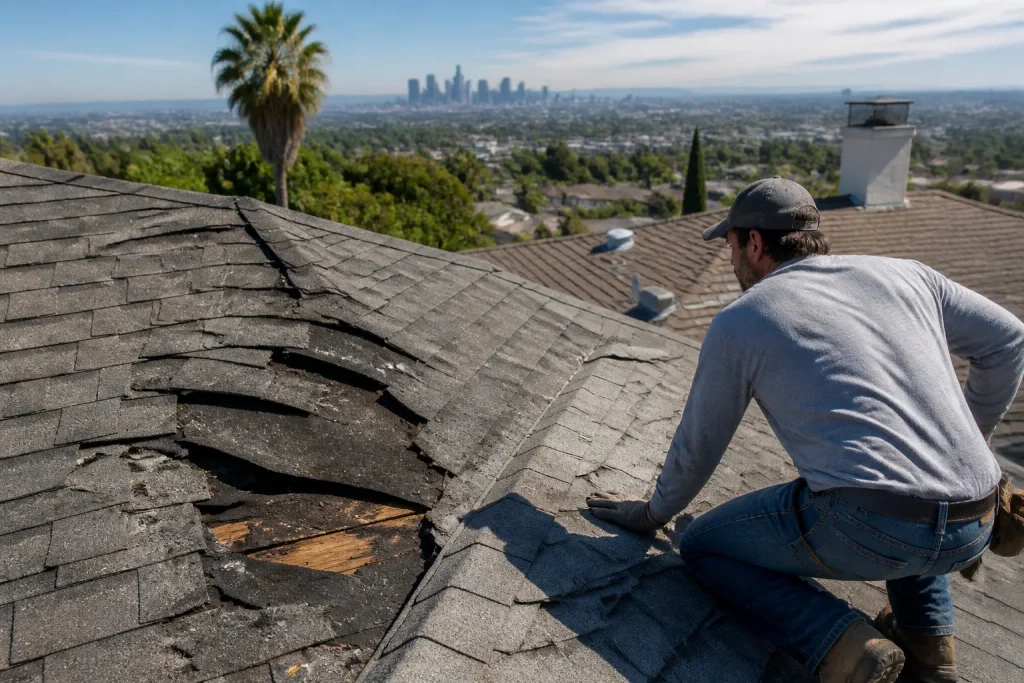
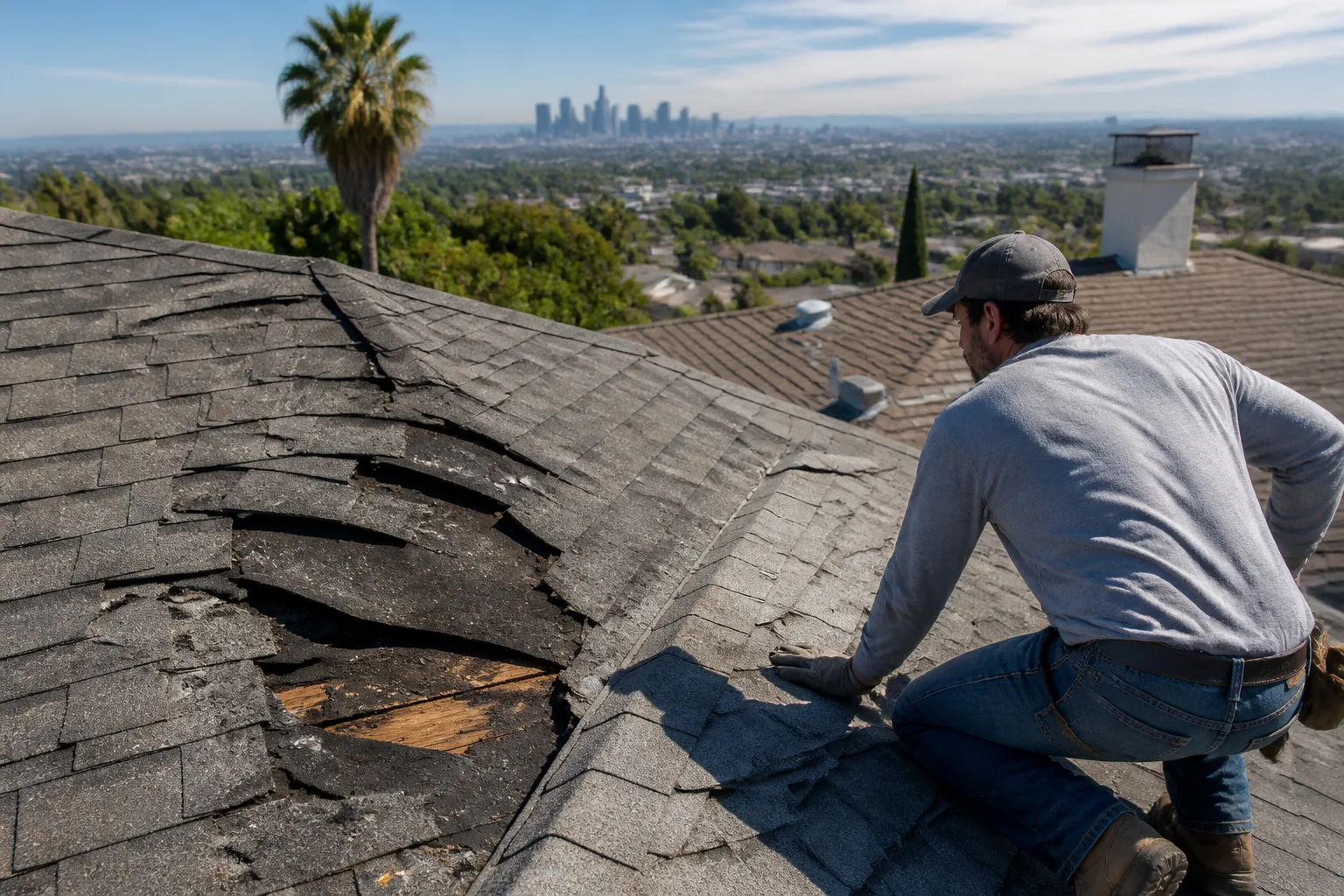
First: nail pops and raised nails across multiple slopes. A single loose nail can be resealed. When you see them across several sections of the roof, it means the decking underneath has been moving for years. The fasteners are working themselves out because the substrate is shifting. Patching the shingles won’t stop what’s happening underneath.
Second: soft spots in the plywood or OSB decking. This one is simple. If the decking under the shingles is soft, it’s holding water. And if it’s holding water, it’s rotting. We find this most often on Los Angeles homes built in the 1980s and 1990s with original OSB that’s had two layers of shingles over it. You can’t fix decking from the top.
Third: shingle seals that have failed across the entire roof, not just one section. In high heat, the adhesive strip on a shingle bakes dry and releases. When that happens everywhere, the roof isn’t shedding water as a system anymore. It’s a collection of loose pieces waiting for the next Santa Ana wind event. Replacing individual shingles works when the rest of the seals are intact. When they’re all gone, you’re throwing money at a roof that’s already done.
How do you ask a contractor to show you these in writing? Simple: “Can you note in the estimate which slopes have failed seals, how many nail pops you counted, and whether the decking feels soft anywhere?” A contractor who will put that in writing is someone who actually went on the roof. The one who won’t, probably didn’t. If you’re in Los Angeles and considering your options, we cover the full picture on our Roofing Company in Los Angeles page.
How to Do the Repair-or-Replace Math Yourself
Here’s where a written itemized estimate becomes the most useful tool you have. When you get a repair estimate, take the total number and divide it by the cost of a full replacement. If the repair is more than 30% of replacement cost, and the roof is past the halfway point of its expected life in your specific Los Angeles microclimate, replacement is usually the smarter money. You’re about to spend a third of a new roof to buy a few more years on an old one.
Let’s put numbers on it. Say a full replacement on a 1,800-square-foot Los Angeles home runs around $18,000 to $24,000 with a mid-grade architectural shingle from Atlas or Tamko. A repair that addresses failed seals, a few cracked shingles, and reseals the flashing might come in at $4,500 to $6,500. That’s roughly 25% of replacement cost. On a 10-year-old roof in Sherman Oaks, that repair probably makes sense. You’ve got another 5 to 8 years left, and the repair keeps the roof functional through that window.
Now take the same roof at 16 years old in Tarzana, with soft decking in two spots. The repair to replace the decking, patch the shingles, and reseal the seams might hit $8,000 to $9,000. That’s about 45% of replacement cost. And you’ll still have a 16-year-old roof over the rest of the house. In that case, replacement is the better investment, because the repair is a down payment on a problem that’s going to keep growing.
The key is that the estimate has to be itemized. A single line that says “roof repair – $6,500” tells you nothing. You need labor broken out, materials listed by brand and quantity, and a clear scope of which slopes or sections get worked. If a contractor won’t give you that, they’re asking you to trust a handshake, and that’s not how we work. Every Birchbark estimate includes a written price before anything starts, always, with the scope in plain English.
The Los Angeles Resale Angle: What Buyers Actually Ask About
If you’re planning to sell in the next 3 to 5 years, the repair-or-replace question gets complicated by what Los Angeles buyers actually care about. Here’s what they ask: “How old is the roof?” and “Has it had any recent work?” A documented repair with photos and a receipt can close a sale just as effectively as a brand-new roof, as long as the roof is still functioning and the inspection doesn’t flag the three findings above.
Los Angeles real estate moves fast, and buyers often waive contingencies to win a bid. But the roof is one of the few things a home inspector will still flag in a report, and a flagged roof gives a buyer leverage to ask for a credit. A seller who can show that the roof was repaired by a company that put everything in writing, including the clean-up photo, removes that leverage. The repair doesn’t need to be recent. It needs to be documented.
That said, if the roof is 18 years old in a hot Valley zip code and you know you’re listing in 2026, replacing it now means you get a few years of use before you sell, and you can disclose a roof age of “new as of 2025” instead of “original roof, age unknown.” That single line in a disclosure package changes how buyers see the house. We’ve watched homes in Burbank and Glendale sit on the market longer than they should have because the roof age was a question mark. A documented answer, either repair or replacement, is what moves the sale. For a deeper look at what replacement involves, Roof Replacement in Los Angeles walks through it step by step.
What a Trustworthy Repair-or-Replace Conversation Sounds Like
You can tell a lot about a roofing company by how they answer the question. A company that only wants the replacement job will say things like “we don’t really do repairs” or “a patch just isn’t worth your money” before they’ve even seen the roof. A company that only wants the repair job will minimize the inspection findings and tell you not to worry about the soft decking. Neither one is advising you. They’re advising their revenue.
A trustworthy conversation sounds different. It sounds like this: “Here’s what I found on the north slope, here’s what it means, and here’s what I’d do if this were my house.” It includes specifics, not vibes. It names the number of failed seals, the condition of the flashing, and what the decking felt like. It includes a written estimate with the repair scope priced line by line. And it includes a straight answer to the question “if we repair now, how long until we’re back here doing this again?”
In our experience, Los Angeles homeowners can handle the truth. They’re not afraid of a $20,000 number if they understand why the roof needs it. What they’re afraid of, reasonably, is paying $9,000 for a repair and then finding out in two years that they needed the full replacement anyway. The way we avoid that is by being specific on the estimate and honest in the conversation. The roof might be a one-time job. The trust isn’t.
One more thing that matters: the crew’s footprint. Los Angeles homeowners with kids and pets worry more about what a roofing crew does to the inside of the house than what they do on the roof. When we do a repair or replacement, we put down drop cloths through the hallway, wear shoe covers at the door, and take a photo of the completed clean-up before the crew leaves. If the dog needs to stay inside, we coordinate the door schedule with you. We use pet-safe products where there’s a choice. It’s the kind of thing you notice when it’s not done, so we make sure it is. That’s the Cedarwell Care Promise, and it’s stamped on every job we do.
The Bottom Line
Most Los Angeles roofs under 12 years old can be repaired. Roofs between 12 and 18 years old depend on the inspection: failed seals in multiple slopes, nail pops, and soft decking are the three signs that repair is a bad investment. Use a written itemized estimate to do the math yourself, and keep the 30% threshold in mind. In LA’s resale market, documented repair is often as valuable as replacement, as long as it’s documented well. If you’re in Los Angeles and need help deciding, Birchbark Roofing home is where you’ll find free estimates with a written price, a Done Right Promise, and a live person who answers the phone every time you call. Reach us at (424) 766-4937.
Frequently Asked Questions
Most roof repairs in Los Angeles run between $500 and $2,500 for minor fixes like resealing flashing or replacing a handful of damaged shingles. Larger repairs that address failed seals across multiple slopes or replace sections of decking typically fall between $4,000 and $9,000. You’ll see your exact number in writing before any work starts. Call (424) 766-4937 for a free estimate.
The answer comes from the inspection. If your roof is under 12 years old and the problems are isolated, repair is almost always the right call. If the inspection finds failed shingle seals across several slopes, multiple nail pops, or soft spots in the decking, replacement is usually the better financial choice, even if a repair looks cheaper upfront. Ask your contractor to put those findings in writing.
Composition asphalt shingles are the most common roof in Los Angeles, and we regularly work with materials from Owens Corning, IKO, Atlas, and Tamko. In hotter Valley neighborhoods, UV-resistant architectural shingles hold up better than basic three-tab. The right product depends on your specific zip code, which is part of what we evaluate during an estimate.
Yes, when permits are required. In Los Angeles, a full replacement almost always needs a permit from LADBS, and a legitimate contractor will handle that for you. Repairs that don’t involve structural changes or full re-roofing may not need one. Either way, the contractor should be able to explain exactly what’s required for your project and include it in the written estimate. If they won’t discuss permits, that’s a red flag.
Written by the team at Birchbark Roofing.
Need Roofing Help?
Call Birchbark Roofing - licensed & insured, here with fast after-hours help in Los Angeles.
(424) 766-4937