
Top Signs You Need Roofing Service – Don’t Ignore These
The earliest signs you need roofing service in Los Angeles are rarely the ones you can see from the driveway. Instead of waiting for a ceiling stain, look for granule buildup in your gutters, water ponding on low-slope sections, and moisture wicking along the underside of your eaves. These quiet signals show up months or years before a leak reaches your drywall, and catching them early usually means a repair in the hundreds instead of a replacement in the thousands. If you’d rather not climb a ladder and look for them yourself, call (424) 766-4937 and we’ll walk you through it.
Most Los Angeles homeowners call us after the roof has already failed. We understand why. The roof is up there, the signs are subtle, and life is busy. But after 25 years of roofing in this city, we can tell you that the first signs of trouble are almost never the ones people notice. The average Los Angeles homeowner waits until water hits the drywall to call a roofer. By then, what could have been a $400 repair has typically become a $4,000 one. This post outlines the early signals worth learning, because they’re the difference between a quick fix and a full tear-off.
- Granule loss in gutters is the earliest measurable sign of shingle degradation, and you can check it from the ground with a simple method we describe below.
- Los Angeles flat and low-slope roofs hide ponding water that may not show up inside for months; a specific ground-level visual check catches it early.
- Moisture wicking on the underside of roof overhangs is visible from a ladder and is one of the most overlooked early warning signs.
- Interior signals like attic condensation and paint bubbling on top-floor walls often point to ventilation failures tied to Spanish-tile conversions, not actual leaks.
- Photographing your roof’s current condition before any service visit creates a written, dated baseline that protects you if any dispute arises later.
1. Granule Loss in Your Gutters: The First Measurable Sign
Shingle granules are the sandpaper-like coating on asphalt shingles that block UV rays and add fire resistance. As shingles age, they shed granules. The problem is that most Los Angeles homeowners never look at their gutters because they’re at eye level only when you’re standing on a ladder. But when we’re called out for what seems like a minor repair, we often find the gutters full of granules, which tells us the shingles have been degrading for a year or more. Here’s how to check it yourself: during the dry season, run a hose along a section of the roof for 30 seconds, then check the downspout. If you see a visible slurry of dark granules collecting at the elbow of the downspout, that’s a measurable loss. A small amount is normal for a new roof. A thumbnail-deep pile after one light rinse is not.
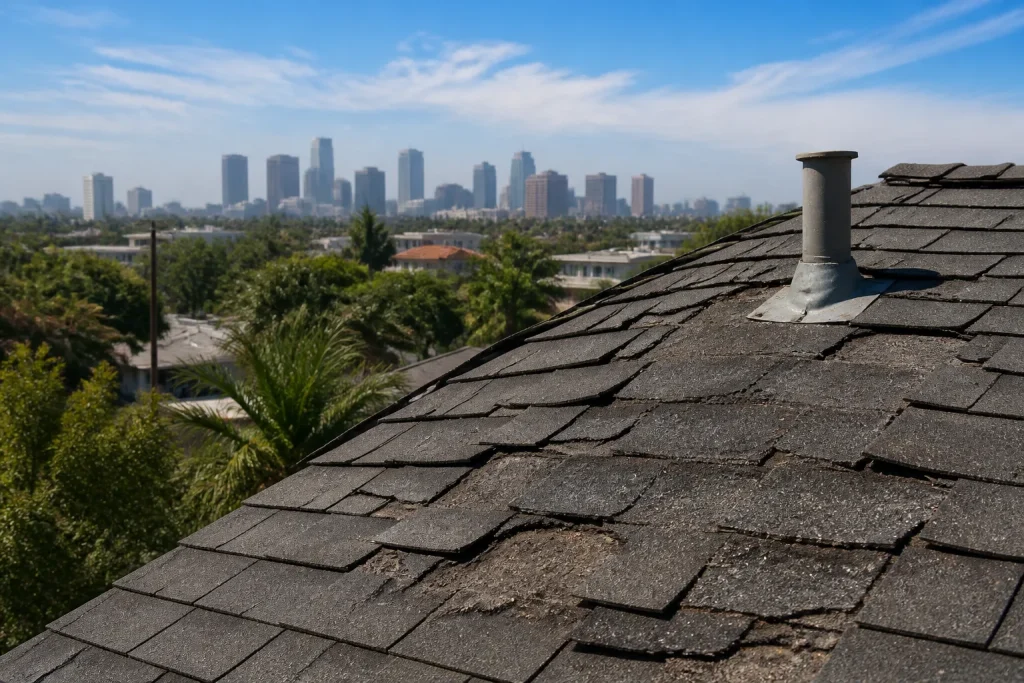
What most guides won’t tell you is what a concerning amount actually looks like. Picture a standard coffee filter. If you collected the granules and they fill half of that filter, you’re at the point where shingles are losing their protective layer faster than the weather can wear them down. We’ve seen valleys on Los Angeles hillside homes where granule loss has exposed the asphalt base, which looks like dark, almost black patches against the lighter gray of a shingle’s surface. That’s not a cosmetic issue. Exposed asphalt bakes in the sun, becomes brittle, and cracks. Once it cracks, water gets under the shingle and starts working on the underlayment. For a closer look at how our repair process handles this, see Roof Repair in Los Angeles.
2. Ponding Water on Low-Slope Roofs: The Hidden Slow Leak
Los Angeles has tens of thousands of homes with flat or low-slope sections, often over additions, garages, or the classic mid-century modern wing. Unlike a pitched roof that sheds water in seconds, a low-slope roof holds water. A small amount of ponding after a rain is normal. Water that still sits there 48 hours after rain is not. And here’s the part that catches people off guard: ponding water on a flat roof rarely shows up inside the house for months. It works on the seams and flashings slowly, and by the time you see a brown ring on the ceiling below, the membrane has failed and the insulation is soaked. At that point, the repair isn’t a patch; it’s a section replacement.
You can check for ponding from the ground, but you have to know what to look for. After a rain, stand in your yard and look at the flat sections. You’re looking for three things: a visible sheen of water that lingers, a dark outline where water has evaporated and left a stain on the roof surface, and small piles of debris that seem to collect in the same spot every time. All three tell you water is pooling and not draining. A fourth sign, visible only from above, is a soft spot: a section of the roof that feels spongy underfoot. If you have a low-slope section and haven’t had it looked at in a few years, it’s worth a check. We’ve pulled one out of a garage over in Eagle Rock last week where the ponding had been hidden for so long that the OSB decking had delaminated, and the homeowner had no idea until we lifted the membrane. For a broader look at how we evaluate roofs across the city, start at Roofing Company in Los Angeles.
3. Moisture Wicking on Roof Overhangs: The Sign You Never Thought to Check
Here’s the check that catches more early roof problems than any other, and almost no homeowner does it: look at the underside of your roof overhangs, the horizontal board that runs along the edge of the roof where it meets the exterior wall. In Los Angeles, that board is usually painted and dry. When a roof has a small leak at the drip edge or a failed underlayment near the gutter line, water wicks back along the underside of that overhang. The paint doesn’t bubble like it does on drywall. Instead, it starts to look water-stained, soft, or slightly darker in streaks. Sometimes there’s a faint white or green fuzz from trapped moisture. If you run your hand along it (safely, from a ladder), a wicking area feels cooler and slightly soft compared to the rest of the board.
This particular sign matters because it’s visible from a ladder at the gutter line, which is where most homeowners can safely look without walking on the roof. You don’t need to get on the roof to check it. You need a ladder, a good angle, and daylight. Look at the overhang where the roof meets the wall on the sunniest side of the house first; in Los Angeles, that’s usually the south or west exposure. The sun’s heat pulls moisture toward the heated side, so wicking shows up there first. If you see it, call us before it spreads. The fix at this stage is typically a re-seal at the drip edge and possibly a short section of new underlayment. Left unchecked, the same moisture rots the fascia board and the rafter tail, and that repair gets expensive fast. If you’re thinking about a full Roof Replacement in Los Angeles, understanding what’s happening at the eave line is step one.
4. Interior Signs Beyond Ceiling Stains: Attic Condensation and Paint Bubbling on Top-Floor Walls
Ceiling stains get all the attention, but by the time a stain forms, water has traveled through the roofing material, the decking, and the insulation. The earlier interior signs are often in the attic and on the top-floor walls. In the attic, look for condensation patterns on the underside of the roof sheathing, especially in the morning after a cool Los Angeles night. If you see a fine mist or small water beads on the plywood, the attic isn’t ventilating correctly. Moisture from inside the house rises, hits the underside of a warm roof, and condenses. Over months, that condensation soaks into the sheathing and creates the conditions for mold. The roof isn’t leaking. The roof is trapping moisture. The fix is usually a ventilation correction, not a roof replacement.
On top-floor walls, paint bubbling is a signal most people blame on old paint or humidity. But top-floor wall bubbling that appears only on walls facing the same direction as the roof’s sun exposure is often tied to roof-adjacent moisture. On Spanish-tile conversions in Los Angeles, the original roof often lacked the proper ridge and soffit vents, because the original roof was not designed for the heavier tile profile. When we see bubbling paint on top-floor walls in a tile-roof home, our first thought is ventilation. The fix isn’t drywall work. It’s adding ventilation at the ridge or eave, and sometimes both. If you’re in a tile-roof home and notice attic condensation or top-floor paint issues, don’t repaint. Have the roof’s airflow checked first. A paint fix without a ventilation fix will peel again within a year. We use materials from GAF, CertainTeed, and Owens Corning for ventilation and underlayment corrections, but the first step is always the inspection.
5. The Paper Trail: Photographing Your Roof Before Any Service Visit
Here’s a step that costs you nothing, protects you in a dispute, and tells a roofer more than any verbal description: before you call anyone, take clear photos of your roof’s current condition. Stand in the four corners of your yard and photograph each roof plane. Get a close-up of the gutters where granules accumulate. Photograph the underside of the overhangs. Take one photo of the attic sheathing from the access point. Date-stamp the photos or save them in a folder with the date in the file name. What you’ve just done is create a baseline. If a contractor later claims a certain area was damaged when they arrived, or if a second contractor disputes what the first one did, you have a documented starting point.
This matters more in Los Angeles than people realize. Roofs here age unevenly. The sun-side of a roof bakes while the shady side stays intact. A contractor looking at the sun-side might say the whole roof needs replacement when the shady side has years of life left. A photo set taken before any visit lets you compare what each contractor says against what you photographed. It also lets you ask a sharper question: “You say the decking is soft here, but my photo from three months ago shows no sign of it.” The photos don’t prove anything by themselves, but they anchor the conversation in evidence instead of opinion. Good roofers welcome this. They make their own photo records anyway. We photo-document every job from the first inspection through the final clean-up and send you the photos, so you never have to wonder what was done up there.
When to Call a Pro
If any of the signs above sound familiar, the next step is a professional look. We said earlier that the average Los Angeles homeowner waits too long, and it’s not because they don’t care. It’s because calling a roofer feels like opening the door to a big unknown number. So let’s remove that unknown. When you call us, a live person answers. We send a background-checked, uniformed technician who puts shoe covers on at the door and drop cloths through the hallway. The estimate you get is written, in dollars, before any work starts. And if the work isn’t done right, our Done Right Promise means we make it right. That’s the entire deal, spelled out before anyone climbs a ladder.
Related services in Los Angeles: If you’re in Los Angeles and need an inspection, a repair, or a full replacement, start with our Birchbark Roofing home page. From there you can read about Roof Repair in Los Angeles and Roof Replacement in Los Angeles. We also serve the broader LA area, and our Roofing Company in Los Angeles page covers our full service area. C.A.R.E. is how we run every visit: Clean up like it is our own home; Ask before we move or touch anything; Respect the family’s time and quiet hours; Explain the price before the work.
The Bottom Line
The roof gives you early warnings. Granule loss in the gutters, ponding on flat sections, moisture wicking along the overhangs, attic condensation, top-floor paint bubbling. None of these require getting on the roof to spot. They require a ladder, a hose, a phone camera, and about twenty minutes. The cost of learning them now is time. The cost of ignoring them is a repair bill that’s ten times what it would have been. If you’re in Los Angeles and want a professional look, Birchbark Roofing offers free estimates and a written price before any work begins. Call (424) 766-4937 to schedule yours.
Frequently Asked Questions
The earliest signs are granule loss in gutters, ponding water on low-slope sections that lingers more than 48 hours after rain, moisture wicking along the underside of roof overhangs, attic condensation, and paint bubbling on top-floor walls. Most of these appear months or years before a ceiling stain shows up. If you notice any of them, call (424) 766-4937 for a free estimate, and we’ll determine what needs attention before it becomes a larger repair.
Early-stage fixes in Los Angeles typically run between $300 and $800 depending on the issue. A re-sealed drip edge, a short section of new underlayment, or a ventilation correction is usually in that range. Once water reaches the decking or the insulation, the repair cost typically climbs into the thousands because the section has to be opened, dried, and rebuilt. The earlier you catch a problem, the smaller the number on your written estimate. For an exact quote on your specific roof, call (424) 766-4937; estimates are free and the price you see is the price you pay.
You can check for most of these signs yourself without walking on the roof. Granule loss is visible from a ladder at the gutter line or from the ground after a hose rinse. Ponding is visible from the yard after rain. Overhang moisture and attic condensation are visible from a ladder and from the attic access point. The only thing we recommend against is walking on the roof itself. Roof surfaces in Los Angeles can be brittle from sun exposure, and a fall is not worth the inspection. If you’d rather not climb a ladder at all, we’ll do the full check for you and photograph everything we find.
No. Birchbark Roofing gives you a written price in dollars before any work begins, and that number doesn’t change unless you ask us to do additional work beyond the original scope. If during the job we discover something that wasn’t visible during the estimate, we stop, show you photos, explain what we found, and give you a new written number before we proceed. You approve the additional work in writing or we don’t do it. That’s the standard on every job performed. Call (424) 766-4937 to schedule your free estimate and see your number in writing.
Written by the team at Birchbark Roofing.
Need Roofing Help?
Call Birchbark Roofing - licensed & insured, here with fast after-hours help in Los Angeles.
(424) 766-4937